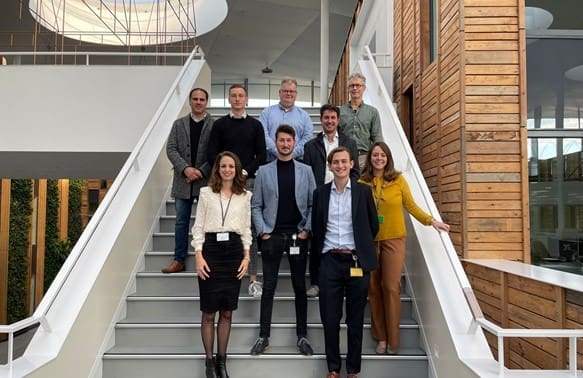
On Monday, September 27, 2021, a team of 11 people from network company Alliander and Supply Value started preparing the European tender MRO items. The aim was to have this tender written in 10 working days. Supply Value spoke with Annemieke Theloosen and Anouk van Dam about how they experienced this process.
About MRO articles
MRO stands for Maintenance, Repair and Operations. These items are necessary to maintain Alliander’s primary process, namely the construction and maintenance of the gas and electricity networks, and are used by mechanics, contractors and in projects carried out by and for Alliander. Examples of these items include tools, fasteners, as well as nuts and bolts.
Preparing a tender is a complex process that often takes a long time
At Alliander, it takes an average of about 9 months to publish a tender. It is a complex and time-consuming process. This is because, due to its crucial role in the energy domain, Alliander has to deal with extensive decision-making procedures, often complex issues, a wide range of stakeholders and intensive cooperation between the various business units. Intensive cooperation inevitably leads to discussions. Preparing tenders is often a time-consuming and complex process.
Not all tenders are suitable for this approach
We spent a long time researching which tender you wanted to put on the market with this Supply Value approach. Afterwards, the tender for MRO articles turned out to be quite complex. In retrospect, are you happy that this tender was chosen? Or perhaps you would have preferred a less complex tender?
“We are certainly glad that we prepared this tender with the help of your approach. We ran into time constraints with this tender, but using the 10-day we were able to prepare the documents and present them to the Board of Directors within a very short time frame. It forces us to prepare for more complex issues in a more effective way as well.
The tender for MRO items does characterize the complexity of tenders at Alliander and thus it has been a good test to apply it to other tenders at all.”
The experiences with this approach are very positive
For Alliander, this way of tendering was new. Supply Value, which uses this approach with numerous clients, sees that many organizations struggle to organize the preparation for the tender fun and effective. It is also nice to see that the internal organization closely monitors the progress of the tender. What are your experiences?
“Within Alliander we use the words SAMEN, FOCUS and DOEN (TOGETHER, FOCUS and DOING). The approach of the tender in 10 days fits perfectly with that! The approach helps Alliander to make quicker decisions, spend their time efficiently and it gives 100% focus. The tender in 10 days requires a dedicated team that is released for the 10 days, therefore you are fully focused on the tender. We also found that plenary discussions within the team were often lengthy, but the approach “forced” us to make choices.
However, 10 consecutive days of working together on the tender is quite intensive, it demands a lot from the team and it was difficult to make sure that we did not still sit down to our regular work in the evening.”
The mutual cooperation was smooth
How did the collaboration go? What did you think went well or what could have been better?
“The intensive cooperation was experienced as very pleasant by the entire team. The intensity created a bond of trust: everyone had confidence in each other’s expertise, but also dared to indicate when they disagreed. The Supply Value colleagues were really part of the team and did not stand on the sidelines watching, but actively cooperated. The energizers helped to get to know each other informally, which also made people trust each other and value each other. You think beforehand that an energizer is not necessary, but you really notice afterwards that it helps. The team also really enjoyed it.”
This way of tendering is definitely recommended
Would you tender this way again? “We will definitely tender this way more often and will also look at a hybrid model.” The main reasoning behind this is that it gives Alliander room to publish more tenders on an annual basis, which is going to contribute to its role with regard to the energy transition.
Some lessons learned
- Think carefully about the preconditions in advance and arrange them well. Is the core and validation team represented well enough? Above all, consider which tender documents to deliver could cause delays.
- Think carefully about which standard templates are already available within your organization and where you may still need to rig some things. This will ensure that you do not start blank during the 10-day period.
- Do a tender in 10 days with a dedicated team empowered to make decisions. Dedicated in this case means: that during those 10 days, nothing else should be on the agenda. Also make room to get to know each other personally; after all, you will be working together (very) intensively for two weeks.
- Schedule enough writing time. It is important to describe the client’s questions, requirements and wishes as clearly and concretely as possible. It takes time to get these things down on paper properly, but be sure to keep discussions short from the beginning of the process.
- In addition, plan enough review time so that everyone knows what is in the pieces.
- Be sure to look back every day at what went well and what could be improved, this way you will continue to continuously improve even within the 10 days.
- As a participant in the 10-day period, plan an extra day afterwards to ensure a run-out or to be able to work quietly.
The project team
On behalf of Alliander: Annemieke Theloosen, Wouter Bregonje, Anouk van Dam, Elsbeth Janssens, Roberto Pavan, Marnix de Vries, Thole Prenger and Bert van Norden
On behalf of Supply Value: Joris van Lierop and Vincent Abbenhuis
Tendering in 10 days
Preparing a tender is a complex process that can often take up to 9 months. At Supply Value, we are convinced that it can be done faster. By tackling three parts of the procurement process differently, it is possible to shorten the process to just 10 days. The three ingredients for this are: A dedicated & multidisciplinary team, in-house decision-making, and the use of the Value Sprint Method. Download the toolkit here to learn more!